Showing posts with label XBox. Show all posts

Thursday, April 18, 2013

Game Review: Goldeneye: Rogue Agent

Goldeneye: Rogue Agent
  • Publisher: EA Games 
  • Developer: EA Los Angeles 
  • Release: PlayStation 2 / GameCube / XBox, 22 November 2004 
  • Genre: Action (First-person shooter) 
  • Players: 1-4 
I get the feeling that the world regards Goldeneye 007 (Nintendo 64, 1997) as some sort of sacred cow, and for good reason I might add. But saying that would be a disservice to certain other games to bear the James Bond licence. For example, the EA-published The World Is Not Enough (N64, 2000) and Nightfire (PS2/GCN/XBox, 2002) both build off of Goldeneye's traditions but with welcome tweaks providing a more comfortable single-player experience, plus the same degree of customisation in the multiplayer department, but with AI bots providing a more comfortable single-player experience. So obviously someone was gonna mooch off its success and reputation by simply using the word in a title. Said entity turned out to be then-licence holder EA, who as a slave to the religion of yearly releases put out Goldeneye: Rogue Agent in 2004, and does it capture such magic? Well... if I have to ask, then you know it's gonna be "no". Let's find out just how "no" it takes things.

The first thing you should know about Rogue Agent is that it both is and isn't a James Bond game. 007 himself only shows up as an NPC in the first mission, a training simulation based on the Fort Knox scene from Goldfinger, and he "dies" early on. The player-character, code-named "Goldeneye", is fired from MI-6 for the mishap, only to ally with Auric Goldfinger's enterprises. Together with the likes of Oddjob, Pussy Galore, and Scaramanga, they wage war against Dr. No, all of whom are alive because screw canon. The core concept to take from all this is that you are a bad guy squaring off against other bad guys, and thus have the freedom to kill the non-protagonistic bad guys in all manner of ways which would be too good for Her Majesty's Secret Service.
Consoles like these operate machine traps.
First and foremost, at all times you have the ability to hold two guns at once, and fire each separately with the left and right trigger buttons. Your arsenal includes the standard array of pistols, machine guns, shotguns, and powerful but two-handed rifles and rocket launchers. More exotic fare include a sticky-bomb launcher and a gun which shoots immobilizing toxins. But not all of your killing implements are portable -- numerous machine traps exist in which you flip a switch and enact some sort of crushy, burny, or droppy demise upon your prey. These things are more prevalent in the earlier levels, and require you to corral targets into a specific location. But the game seems to exercise some sort of soft coercion to get you to sample the array of deaths at your disposal; using machine traps, special weapons, or other unique killing methods earns you Rogue Bonus points which potentially unlock content for the multiplayer mode which, sadly, has done away with the AI bots. Man, that sucks for us "forever alone" types...

More prevalent are the abilities bestowed upon you by your player-character's golden gadget eye, hence the title. Starting from the second level on, a new Goldeneye power is unlocked for each mission. First is MRI Vision, which reveals enemies from behind walls. Best used in conjunction with the Mag-Rail gun, which is slow to fire but shoots through walls (oh, that's another type of Rogue Bonus!). In level 3, you get the EM Hack, which disables enemy guns and can turn on machines from afar. In level 4, you get the self-explanatory Polarity Shield, and for level 5, you get the Induction Field, which grabs and throws enemies through pseudo-telekinesis. All four abilities are limited by a power level which recharges automatically. So does your health. Body armour doesn't regenerate, obviously, but it's so frequently dropped by enemies that it might as well. And maybe it's just my playing style, but grenades seem to be more effective in Rogue Agent than in other first-person shooters I have experienced.
MRI Vision reveals enemies behind walls.
Good thing you have all that in your corner, because even by the standards of other James Bond licenced-games, Goldeneye: Rogue Agent is hard. (What I perceived as) the difficulty stems mainly from the fact that enemies, even common mooks, take an unrealistically huge quantity of bullets to bring down, and they don't stagger from hits, either. Must be all that armour, which would explain why they "bleed" blue sparks instead of blood. And while I admit I don't care too much, within reason, about enemy AI in these kinds of games, Rogue Agent is for the most part above-average in this department. They call out comments on your current weapon and position, and run in zig-zag patterns to throw off slower weapons like the aforementioned rail gun, but it's nice of them to not run around your own cover and hit you from behind. Huh, I guess I pay more attention to AI than I thought. Still, as if all that wasn't bad enough, your maximum ammo is limited, and somehow it's hard to consistently pick up new ammo dropped by enemies. Like, we're talking as few as two spare magazines in addition to what's in your gun(s) at the moment.

But the point which clinches it for me is how long the levels are. There are only eight levels in all, but barring the first two, they can take upwards of an hour to complete. Compare that with, say the 1997 Goldeneye, which had 20 levels which generally lasted no longer than ten minutes apiece. Call it my bias, but a format like that invites me to go back to the game again and again and replay the missions just for fun. With Rogue Agent, on the other hand, each level is a endurance test, something I dread going back to. And it's that one little point which relegates Goldeneye: Rogue Agent to the status of merely "good" as opposed to "great"; which keeps it from being worthy of standing next to its Nintendo 64 namesake. Or Nightfire.

Positives:
+ Fairly well-executed dual-wespon combat.
+ The weapon combinations and Goldeneye powers give you lots of ways to play.
+ The enemy AI and dialogue adapt to the current situation.
+ Awesome soundtrack by Paul Oakenfold.

Negatives:
- The levels are too few and too long.
- Difficult in a number of unfair ways.

Control: 4 deathtraps out of 5
Design: 3 deathtraps out of 5
Graphics: 3 deathtraps out of 5
Audio: 5 deathtraps out of 5
Value: 2 deathtraps out of 5
The Call: 65% (C)

Wednesday, November 14, 2012

Game Review: Mercenaries


Mercenaries: Playground of Destruction
  • Publisher: LucasArts
  • Developer: Pandemic
  • Release: PlayStation 2 / XBox, January 2005
  • Genre: 3D Action
  • Players: 1
  • Rarity/Cost: Moderate (US$10-30)

North Korea has always been a fascinating subject for me, despite how sad the whole thing is.  The government has allowed large chunks of its population to starve, established the most extensive and longest-lasting propaganda operation in modern history, imprisons those who try to break that image and lock them up into nigh-unlivable prison camps, lavishes all its attention on a military who would be willing to launch an all-out assault on the West at the slightest provocation, and if you were to ask any of the authorities about this, they would deny it to their last breath.  So yeah, you'll never find a more wretched hive of scum and villany, at least not in this galaxy.  From time to time I have entertained the thought of taking a little tour in North Korea, but it would inevitably end with me attempting to assassinate the leader and/or getting "disappeared", so forget about it.  That's why I've done the next-best thing: experience it in a video game.

Our fictional North Korean head of state, and the game's villain, is General Song, who seized power from his father and started building up the military.  When the Australian navy caught him shipping weapons to terrorists, the United Allied Nations put up a US$100 million bounty for his captured.  (In other news, I think I have a solution to the Syrian crisis.  Anyone got $100 million, three mercenaries, and a bunch of bunker-buster bombs lying around?)  Who's going to take them up on it?  One of three playable mercenaries: Chris Jacobs (formerly of US Delta Force), Jennifer Mui (former British SIS), and Matthias Nilsson (former Swedish Royal Navy).
Killing a faction's soldiers automatically lowers your
relationship rating with them. (XBox version shown.)
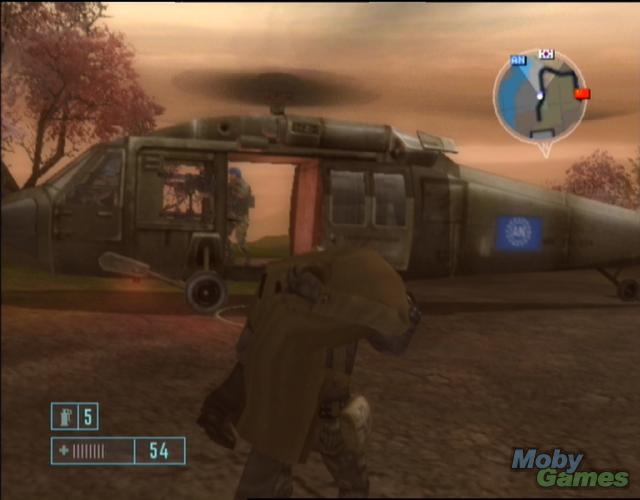
And how are they going to get to General Song?  By taking contracts from multiple factions: the not-United Nations, South Korea, China, and the Russian Mafia.  A good number of missions will pit you against other friendly factions, and by killing their soldiers, you'll ruin your relationship with them, up to the point that they'll refuse to work with you and their soldiers will open fire on you.  In order to fix your standing with them, you'll have to pay a bribe (the cost goes up each time) or kill soldiers from a rival faction (AN & South Korea vs. China vs. Mafia) in front of troops from the faction you're trying to patch things up with. (This mechanic was notably improved in the sequel.)

But it pays to play the sides against each other: your rewards for completing story missions are cash, ordinance and supplies, and the locations of North Korean officials.  Arranged into a "Deck of 52" cards like what was used during the Iraq War (i.e. General Song is ranked as the Ace of Spades), capturing or (for half the reward money) killing these high-value targets (HVTs) fills up an intel meter, viewable in your PDA's menus.  The "number cards", 2 through 10 of each suit, are scattered around the map, and clearing missions for each faction will give you hints on their locations.  On the other hand, the "face cards", the Jacks, Queens, and Kings, have missions dedicated to capturing them, and they fill up a bigger chunk of the intel meter.  You can unlock the Ace missions without having captured or killed all of the HVTs in a particular suit, but while I do admire this flexibility, completing an Ace mission will permanently lock you out from finding any remaining HVTs, so beware if your goal is 100%-completion.  You might also want to save before and after attempting to capture an HVT alive, lest an errant explosion kill him or her against your wishes.  Save Scumming: it's how the pros do it!

Call a helicopter to pick up HVTs,
but clear the landing site first!
(XBox version shown.)
And now for the feature which sets Mercenaries apart from the Grand Theft Auto trilogy which inspired it.  In this game, you are able to order airstrikes, vehicles, and supplies anywhere from your PDA (the PDA bit was sadly left out of the sequel).  However, instead of getting your supplies from each of the factions, all business is conducted through the Russian Mafia, and if your standing with them has soured, they'll lock you out of their services until you bribe them or what-not.  Another little thing I was pleased they included: you not only have a lifebar for your character's health, but also the life of your current vehicle, something which oddly has been missing from the Grand Theft Auto games.  Then again, the vehicle physics are on the light side, with most collisions tossing your car around like a tornado-induced tailspin, so forget about it.

The world of Mercenaries: Playground of Destruction consists of two large maps, one for each half of the game's story.  When you take that into account, it becomes understandable that the loading times are on the unfriendly side, and a heaping helping of fog limits the real estate that is drawn on screen.  (The latter, if not the former, was also improved in the sequel.)  Nonetheless, frame rates are generally stable, and there's quite a bit of bloom lighting to be had, but the washed-out colour palette may not be to everyone's taste.  Of course, I'd imagine the real North Korea is similar in that regard.  There's not a lot of music to be had, either, but when it does play, it's grand orchestal fare which would fit well in a movie.  Then again, you could watch the upcoming remake of Red Dawn to get the same effect.  But you'd miss the personality of the voice-actors, including Phil LaMarr (Chris), Jennifer Hale (Jen), and Peter Stormare (Matthias), who leave no doubt that they love blowing stuff up.

It's true that Mercanaries is nowhere near a perfect game.  One of the game's weakest points is the AI.  Take for example the helicopters you call in to extract high-value targets.  It takes effort to find a suitable landing spot, since even the slightest bit of uneven terrain and the chopper will reject your call.  Even if you do manage to bring it in, there's a possibility that it could touch down on a stray rock or car, and get tossed around.  And it appears that the computer-controlled North Korean soldiers have no qualms about letting their unit leaders (read: HVTs) get blown up by stray explosions, which is why I stressed the importance of saving.  (Save early and often, like voting in Florida! >:-) )  So whilst Mercenaries: Playground of Desctruction is rather unpolished, it takes the wide-open-sandbox genre in directions few have bothered to go down, and is certainly worth a try for such reasons.

Control: 3 airstrikes out of 5
Design: 4 airstrikes out of 5
Graphics: 3 airstrikes out of 5
Audio: 3 airstrikes out of 5
The Call: 75% (B-)

Friday, January 20, 2012

Dance Dance Retrospective: Class of 2003

As there were four years between Extreme and the next arcade release, I'll be doing something a little different for this installment in Dance Dance Retrospective.  Instead of focusing one whole entry on one particular game, I'll be touching on a bunch of the home games released in the year 2003, from all three major game markets: Japan, North America, and Europe.

Japan

For the Japanese market, 2003 saw the home ports of MAX2 and Extreme, as I had previously mentioned.  But after all that, they got a third title: Dance Dance Revolution Party Collection (PlayStation 2, 11 December 2003).  There's little in the way of original content to speak of, with only five or so brand-new songs out of a total 47, and an interface that's basically a re-skinned Extreme.  Like Extreme before it, Party Collection takes a greatest-hits approach, relying on revival songs from across the entire series to date, including the Dancemania licences that were brought back for Extreme.

North America

American and Canadian PlayStation 2 owners got their own version of MAX2, which again I had glossed over before, in the Fall of 2003.  But the XBox faithful were also blessed with Dance Dance Revolution Ultramix (XBox, 19 November 2003), the first "major" DDR release on a non-Sony console.  Despite the extra graphical horsepower the XBox has over the PS2, Ultramix looks similar to its contemporary, with cel-shaded dancers and the same FMV backgrounds from MAX.  But what made Ultramix stand out is how it integrated with XBox Live, the console's online service.  In addition to playing songs with people over the Internet, users could also buy packs of online-exclusive songs, pre-dating similar features in Guitar Hero and Rock Band by years.

Ultramix was developed by Konami's Hawaiian branch, and so some of the fans took issue with some of the game's stepcharts, which were a bit heavy on the Freeze Arrows.  As such, some of the songs from this game were given new Heavy-level charts in subsequent appearances.  That's not to say the game was a total loss, far from it; the Ultramix series spawned a total of four games between 2003 and 2006.  Unfortunately, none of the Ultramix games are backwards-compatible on the XBox 360, but they did follow them up with the Universe series, which saw 3 games in 2007 and 2008.

Europe

After the stellar, arcade-only Euromix 2, would Konami of Europe see fit to release a port for home gamers?  Sadly, no; while there were two games released for the PAL region, they both sucked in comparison to their foreign peers.  First is Dancing Stage Megamix (PlayStation 2, 30 May 2003).  It looks identical to Euromix 2, but only contains 28 songs - compare that to most of the American PS2 games, which average 70 songs a pop.  And the new licence songs from Euromix are nowhere to be seen; Megamix replaces them with 7 hit tracks including "A Little Less Conversation" by Elvis vs. JXL, "Love At First Sight" by Kylie Minogue, and "The Lovecats" by The Cure.  And all 7 of these songs only rank at 4 feet on Expert.  The soundtrack is rounded out by some of the Konami Originals from MAX and EuroMIX2, including "Max 300", which at least provides a counterpoint to the stupid-easy licences, but the whole thing is lacking in both quantity and quality.

Then there was Dancing Stage Fever (PlayStation/PlayStation 2, 24 October 2003).  There are 29 songs this time around; the 8 new licences include "All That She Wants" by Ace of Base, "Wannabe" by the Spice Girls, and... really?  "Come On Eileen" by Dexy's Midnight Runners.  But shock of all shocks: some of these songs top out at 7 feet on Expert!  Now, I'm not dissing the lower-tier players when I say stuff like that - after all, that's what the other difficulties are for.  But if you're going to attract the better players with songs they might already know from outside of DDR, they should at least be exciting.  Oh, and wouldn't you know it, they saw fit to make a PSone port of Fever.  There are only 15 songs in this version.  Fifteen songs.  That means stuff like "D2R" and "MaxX Unlimited" were cut from the PS2 version, and since it's based off of 4thMIX, the Freeze Arrows are missing from songs that would otherwise have them.  So yeah, Dancing Stage Fever: it's an improvement in its own market, but by any other standards it's just unacceptable.  Can we jump ahead to 2004 please?